Is daily fantasy sports legal? There is no single American answer. The federal government stepped aside in 2006, and every state since then has written its own rule, opinion or silence. The result is a patchwork: some states license and tax fantasy operators, some leave them unregulated, a few keep them out, and a growing number regulate one kind of fantasy contest while banning another.
Daily fantasy sports legal status changes several times a year. Below is the current picture for all 50 states and DC, showing where daily fantasy sports is legal and offered: where paid salary-cap contests are offered, the minimum age, and the state law or regulator action that shapes it. Availability comes from DraftKings' published eligibility rules, the clearest single list any operator publishes; state law notes come from statutes, regulator actions and Attorney General opinions.
Daily fantasy sports legal status by state: the map
How this map was made
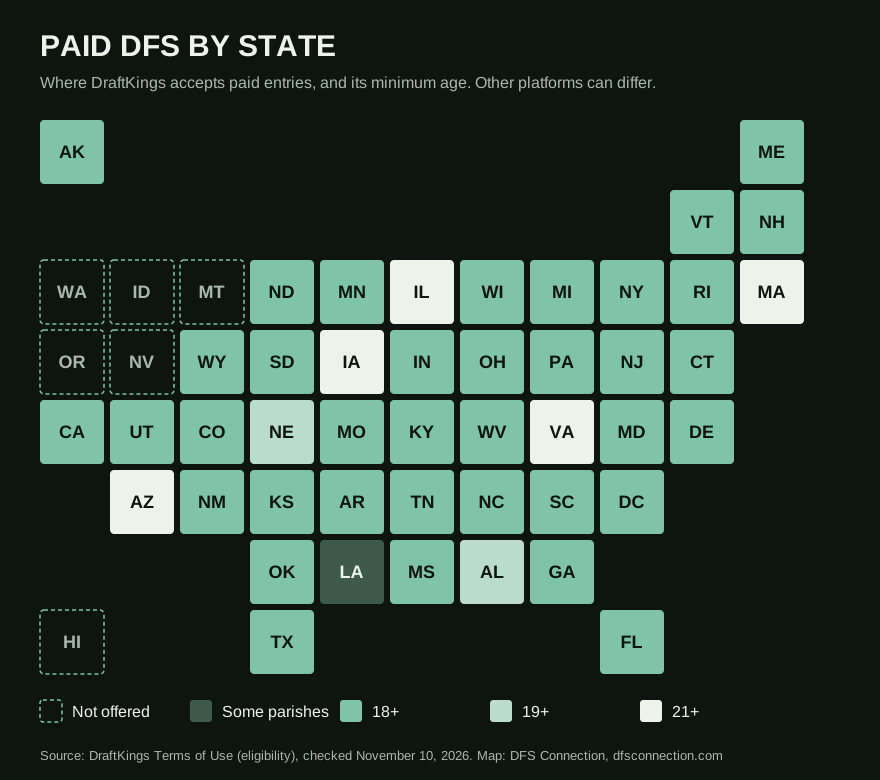
Each tile takes its colour from the eligibility section of DraftKings' Terms of Use, which lists the states where the operator does not accept paid entries and the minimum age in each state; that list was read on November 10, 2026. DraftKings was chosen because it publishes the most complete single list; FanDuel and pick'em platforms keep their own and can differ. The map shows availability, not legal status: a state where contests are offered may still have no fantasy law, or an Attorney General opinion against it. Those details are in the table below. Both are rechecked whenever a state acts, and at least before each NFL season.
Where daily fantasy sports is legal: the states at a glance
Paid salary-cap DFS is offered in 43 states and DC, plus parts of Louisiana. The six states where DraftKings does not take paid entries are Hawaii, Idaho, Montana, Nevada, Oregon and Washington. In Louisiana, fantasy contests are allowed only in parishes where voters approved them.
"Offered" is not the same as "authorised". In Texas and California, paid contests continue despite Attorney General opinions calling them illegal gambling; neither opinion is a statute. Other states, like New York, Ohio and Colorado, have explicit licensing laws and regulators. The full table follows.
| State | Paid DFS | Min. age | State law and recent changes |
|---|---|---|---|
| Alabama | Offered | 19 | |
| Alaska | Offered | 18 | |
| Arizona | Offered | 21 | |
| Arkansas | Offered | 18 | Regulators ordered two pick'em operators out over player props. |
| California | Offered | 18 | No DFS law; a 2025 Attorney General opinion calls DFS illegal sports wagering. Advisory, not a statute. |
| Colorado | Offered | 18 | Regulated by the Division of Gaming; entry caps in large contests; peer-to-peer pick'em only. |
| Connecticut | Offered | 18 | |
| Delaware | Offered | 18 | Regulated; entry caps of 3% or 150 in contests over 100 entries. |
| District of Columbia | Offered | 18 | |
| Florida | Offered | 18 | No DFS statute; the Gaming Control Commission pushed pick'em operators to peer-to-peer play. |
| Georgia | Offered | 18 | No DFS-specific law. |
| Hawaii | Not offered | — | Not offered; a 2016 Attorney General opinion said DFS could be illegal gambling. |
| Idaho | Not offered | — | Not offered while physically in the state. |
| Illinois | Offered | 21 | Licensing framework under the Illinois Gaming Board from July 1, 2026. |
| Indiana | Offered | 18 | |
| Iowa | Offered | 21 | |
| Kansas | Offered | 18 | |
| Kentucky | Offered | 18 | HB 904 (2026) requires DFS operators to be licensed. |
| Louisiana | Some parishes | 21 | Only in parishes that voted to allow fantasy contests. |
| Maine | Offered | 18 | Fantasy contests licensed under 8 M.R.S. §1105; Gambling Control Unit. |
| Maryland | Offered | 18 | Regulated; rules restrict single-player pick'em. |
| Massachusetts | Offered | 21 | Attorney General regulations; player-vs-house pick'em ended after AG action. |
| Michigan | Offered | 18 | Regulated; player-vs-house pick'em banned since late 2023. |
| Minnesota | Offered | 18 | |
| Mississippi | Offered | 18 | Regulated by the Gaming Commission; pick'em must be peer-to-peer. |
| Missouri | Offered | 18 | Gaming Commission ordered operators to stop player-vs-house pick'em. |
| Montana | Not offered | — | Not offered by DraftKings. |
| Nebraska | Offered | 19 | |
| Nevada | Not offered | — | Gaming Control Board treats DFS as sports wagering (2015). |
| New Hampshire | Offered | 18 | State fantasy sports law on the books. |
| New Jersey | Offered | 18 | Legalized in 2017. |
| New Mexico | Offered | 18 | |
| New York | Offered | 18 | Regulated since 2016; operators register with the State Gaming Commission. |
| North Carolina | Offered | 18 | |
| North Dakota | Offered | 18 | |
| Ohio | Offered | 18 | Regulated by the Ohio Casino Control Commission. |
| Oklahoma | Offered | 18 | |
| Oregon | Not offered | — | Not offered by DraftKings. |
| Pennsylvania | Offered | 18 | Legalized in 2017. |
| Rhode Island | Offered | 18 | |
| South Carolina | Offered | 18 | |
| South Dakota | Offered | 18 | |
| Tennessee | Offered | 18 | Regulated. |
| Texas | Offered | 18 | No licensing law; a 2016 Attorney General opinion called paid DFS illegal gambling. |
| Utah | Offered | 18 | |
| Vermont | Offered | 18 | |
| Virginia | Offered | 21 | Oversight moved to the Virginia Lottery Board on July 1, 2026. |
| Washington | Not offered | — | Not offered by DraftKings. |
| West Virginia | Offered | 18 | |
| Wisconsin | Offered | 18 | |
| Wyoming | Offered | 18 | Player-vs-house pick'em ruled illegal in 2024. |
Why the law differs by state
The federal carve-out
The Unlawful Internet Gambling Enforcement Act of 2006 targets payments for online bets, and it excludes fantasy contests that meet four conditions: prizes set in advance and not based on the number of entrants or fees, outcomes that reflect participants' knowledge and skill, results determined mainly by accumulated statistics of individual athletes across several real events, and no outcome based on a single team's score or a single athlete in a single event. That exclusion removed fantasy from one federal law. It did not make DFS legal anywhere; state gambling law still applies.
Skill or chance
Most state gambling laws turn on whether chance or skill dominates the outcome. States that license DFS have generally accepted that skill predominates and written consumer-protection rules around it: age limits, entry caps, segregated player funds. States that keep DFS out have generally decided the opposite, or that a fantasy contest is close enough to a sports bet to need a sports-betting licence. Nevada took that view in October 2015.
Attorney General opinions
In several states the most important document is not a law but an AG opinion: Texas and Hawaii in 2016, California in July 2025. These opinions interpret existing gambling law. They can lead to enforcement or prompt operators to leave, and in Texas paid contests have stayed available for years after the opinion.
Recent changes, 2025–2026
- California, July 2025: Attorney General opinion that DFS, including pick'em, is illegal sports wagering. Advisory; paid contests continued.
- Nationwide, August 2025: PrizePicks ends player-vs-house Pick'Em across the US and moves to peer-to-peer play.
- Virginia, April 2026: a new law moves fantasy oversight from the agriculture department to the Virginia Lottery Board from July 1, 2026, with permits and a 10% tax on fantasy revenue.
- Kentucky, April 2026: HB 904 becomes law after a veto override. DFS operators must be licensed, and licensed operators may not partner with prediction markets.
- Illinois, July 2026: the first fantasy framework in the state takes effect under the Illinois Gaming Board, with a minimum age of 21 and a 15% tax. It defines fantasy as contests between two or more players.
The direction is clear even where the details are not. States are moving from silence to licensing, and from tolerance of player-vs-house pick'em to rules that require players to compete against each other.
Pick'em contests: the separate set of rules by state
Pick'em games ask you to choose whether a player will go over or under a stat line. When the contest is against the operator, regulators in many states see a player prop bet with a fantasy label. Michigan banned the format from late 2023. Wyoming ruled it illegal in July 2024, the first state to do so. Florida's Gaming Control Commission sent cease-and-desist letters that pushed operators out of the format by March 2025. Massachusetts, Missouri and Arkansas took similar steps, and Colorado's rules require peer-to-peer play.
The industry response has been to convert pick'em into peer-to-peer contests, where players compete against each other for a prize pool rather than against the house. That is the format the new Illinois law describes, and it is how pick'em is now run in most states that still allow it.
Age, location and identity rules by state
The minimum age is 18 in most states. On DraftKings it is 19 in Alabama and Nebraska and 21 in Arizona, Illinois, Iowa, Louisiana, Massachusetts and Virginia. Location is checked when you enter, not when you sign up: a player living in Oregon can enter contests while in California, and a player living in California cannot enter while in Nevada.
Several regulated states also limit how many entries a single player can submit in big contests. Delaware's rule, mirrored in Colorado and Mississippi, caps a player at 3% of entries or 150, whichever is smaller, in contests with more than 100 entries. The strategy guide covers what those caps mean for contest selection.
What the map does not tell you
A tile map can show whether contests are offered and at what age, which is most of what people mean by daily fantasy sports legal status. It cannot show how settled the situation is. A state with a licensing law is unlikely to change overnight; a state where contests run under an unenforced AG opinion could. If you play from one of the latter, the safest assumption is that the rules can change between seasons.
The news section follows these changes as they happen. For how the contests themselves work once you are eligible, start with the beginner guide.
Questions readers ask
Is daily fantasy sports legal in the US?
Is daily fantasy sports legal at the federal level? Federal law does not ban it. The 2006 Unlawful Internet Gambling Enforcement Act excludes qualifying fantasy contests from its definition of a bet, but that exclusion does not make DFS legal under state law. Each state decides, and the answers range from full licensing regimes to outright exclusion.
In which states is DFS not available?
DraftKings does not accept paid entries from players located in Hawaii, Idaho, Montana, Nevada, Oregon or Washington, or in Louisiana parishes that did not approve fantasy contests. Other platforms keep their own lists, and pick'em-style games have a separate and longer list of restrictions.
Is daily fantasy sports legal in California?
California has no DFS law. In July 2025 the state's Attorney General issued an opinion that DFS, both draft-style and pick'em, constitutes sports wagering under the penal code. An AG opinion is advisory rather than a statute, and paid contests have continued to be offered while the question remains unresolved.
Is daily fantasy sports legal in Texas?
Texas has no fantasy licensing law. A 2016 Attorney General opinion described paid fantasy contests as illegal gambling, yet paid contests remain available in the state. It is one of the clearest examples of the gap between legal opinion and what platforms actually offer.
Why is DFS not allowed in Nevada?
In October 2015 the Nevada Gaming Control Board said DFS counts as sports wagering, so an operator needs a sports pool licence. The major DFS operators withdrew rather than seek one.
What is the minimum age to play daily fantasy sports?
18 in most states. DraftKings requires 19 in Alabama and Nebraska and 21 in Arizona, Illinois, Iowa, Louisiana, Massachusetts and Virginia. State laws and other operators can set different limits, and Illinois' 2026 framework sets 21 by statute.
Is DFS considered gambling?
Some states treat it as a game of skill and license it separately from gambling; New York's 2016 law is the best-known example. Others, like Nevada, treat it as sports wagering. Federal law exempts qualifying contests from one online gambling statute but does not settle the question for the states.
What happened to pick'em DFS?
Player-vs-house pick'em games, where you choose more or less on player stats against the operator, drew regulator action in Michigan, Wyoming, Florida, Massachusetts, Missouri, Arkansas and other states from 2023 on. In late August 2025 PrizePicks ended its player-vs-house Pick'Em across the US and moved to peer-to-peer play.
Can I play DFS when travelling to another state?
What counts is where you are physically located when you enter, not where you live. Sites use geolocation to block entries from states they do not serve, so a lineup you could set at home may be blocked on a trip.
How often does this state table change?
Several times a year, which is why the question of where daily fantasy sports is legal has no permanent answer. In 2026 alone Kentucky passed a DFS licensing law, Virginia moved fantasy oversight to its Lottery Board and Illinois started a licensing framework. The table is rechecked whenever a legislature or regulator acts.