Most daily fantasy sports strategy advice tries to answer one question: who should I play? That is the wrong place to start. The first question is what you are trying to beat. In a 50/50 you are trying to beat half the field. In a 150,000-entry tournament you are trying to beat everybody, including thousands of lineups that look almost exactly like yours. The same running back can be a good choice for one and a poor choice for the other on the same night.
What follows takes the decisions in the order players face them: what kind of contest, how to build for it, how to correlate players, how to pick a field, what to do at lock, and how much to put in. Football is the running example because its rules are the most standardised, but the logic carries to every sport.
What daily fantasy sports strategy actually decides
A DFS lineup is a set of guesses priced by somebody else. The site sets salaries days in advance; between then and lock, injuries happen, weather changes and depth charts move. Daily fantasy sports strategy decides three things on top of that price list.
- Projection: how many points each player is likely to score, and how widely that could vary.
- Price: whether the projection is high for the salary, which is what "value" means.
- Field: what everyone else will do, which only matters in contests where finishing near the top pays far more than finishing in the middle.
Cash games are mostly about the first two. Tournaments add the third, and it changes the answer more often than people expect.
Cash games vs GPP: two different games
Cash games are head-to-heads, 50/50s and double-ups. They pay a large share of entrants a fixed amount, so the target is a score comfortably above the median. GPPs, the guaranteed-prize-pool tournaments, pay a minority of the field with most of the money concentrated at the very top, so the target is a score higher than almost everyone's.
That difference flips several decisions. In a cash game a popular player is fine; if he scores well, you keep pace with the lineups that also have him, and you still beat the half that do not. In a tournament the same player cannot separate you from anyone who has him. Your edge has to come from somewhere else in the lineup.
| Decision | Cash games | GPP |
|---|---|---|
| What wins | A score above the median | A score near the top of the field |
| Player profile | High floor, secure role | High ceiling, wide range of outcomes |
| Popular players | Fine when the role is real | Fine in moderation; edge comes elsewhere |
| Correlation | Optional | Central |
| Salary left unused | Usually a mistake | Sometimes a deliberate difference |
Building a cash games lineup
Good cash game strategy is boring on purpose. You want the most likely good outcome, not the most exciting one.
Floors before ceilings
A player's floor is what he scores on an ordinary bad day. Running backs with a full workload, receivers who see eight or more targets every week, and quarterbacks who add rushing yards all have high floors because their points come from volume rather than a single big play. A deep threat who catches three passes for 104 yards and a touchdown is a fine result, but the same player can also catch one pass for nine yards.
Use the cap
Salary left unused in a cash game is projected points left on the table. The exception is when the only way to spend it is to swap a secure player for a shaky one; then fifty dollars of slack is the better choice.
Take the obvious value
When a starter is ruled out late in the week and a cheap backup inherits his role, much of the field will play the backup. In cash games that is usually right. The salary has not caught up with the role, and fading him means giving the field a free edge.
Mind the scoring table
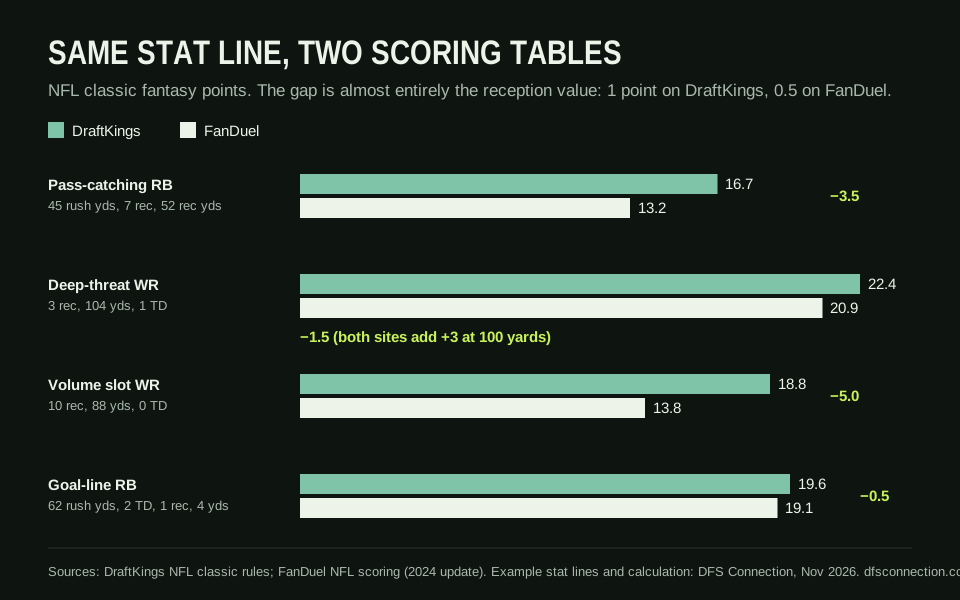
On DraftKings a reception is worth a full point; on FanDuel it is worth half. A running back who catches seven passes gains three and a half points more on DraftKings than on FanDuel for the same afternoon. The infographic below shows how large that gap gets for different player types.
Where these numbers come from
Each bar applies one site's published NFL classic scoring to the same invented stat line: 0.1 points per rushing or receiving yard, 6 per touchdown, a 3-point bonus at 100 yards on both sites, and 1 point (DraftKings) or 0.5 (FanDuel) per reception. The four stat lines are illustrations of common player types, not real games, chosen to isolate the reception value. Scoring tables were checked against DraftKings' rules page and FanDuel's 2024 scoring update in November 2026 and will be rechecked before each NFL season. The chart covers offense only; defense scoring and fumbles are left out because FanDuel's current fumble value could not be confirmed from its own rules page.
GPP strategy: ownership and leverage
Every serious GPP strategy starts from a simple observation: when a player is in 40% of lineups, his good game is shared by 40% of the field. You still need him to score if you play him, but he does not move you past those lineups. That is why tournament players care about ownership, the share of entries that roster each player.
Projected ownership
Sites show actual ownership only after the slate locks. Before that, players work from projected ownership estimates published by research services. They are rough, and they are most reliable for the handful of very popular players everybody can see coming: the cheap backup who just inherited a starting job, the star in the best matchup of the week.
Leverage
Leverage is the return on being different in the right place. If you roster a receiver at 5% ownership and he has the best game on the slate, your lineup jumps past the 95% who do not have him. If you fade a 40% player and he fails, you gain on 40% of the field at once. Neither is guaranteed; the point is that the payoff from being right is much larger when few others are right with you.
Leverage does not mean playing bad players because nobody else will. A low-owned player still has to have a real path to a big score. The useful question is: which player has nearly the same ceiling as the popular choice at the same position, at a fraction of the ownership?
Where to be different
Most winning tournament lineups are not contrarian everywhere. They tend to take the popular, high-value plays where the case is strong and differ in one or two places, often through a stack the field is underweight on. Differing in all nine spots usually means building a worse lineup, not a more unique one.
Stacking and correlation in a GPP lineup
Fantasy points are not independent. When a quarterback throws a touchdown, a receiver catches it. Both score on the same play. Stacking puts players whose outcomes move together into one lineup so that a good game for one makes a good game for the other more likely.
NFL stacks
- QB plus one or two pass catchers: the standard stack. A big passing day lifts all of them.
- Bring-back: one player from the opposing team. If the game becomes a shootout, the other side scores too.
- Negative correlation to avoid: a running back against the defense he is facing, or a quarterback with the opposing defense. Their good outcomes tend to exclude each other.
Baseball and hockey
Baseball stacks consecutive hitters from one lineup: runs scored and runs batted in come in clusters, so four or five hitters from the same team against a weak starting pitcher capture the same big inning. Hockey works on lines and power-play units, since the players on the ice together share goals and assists.
Basketball
NBA points are much less tied together on single plays. Some players target game environments, a high total or fast pace, rather than strict team stacks. Minutes matter more than correlation.
A small aside for anyone who builds with a spreadsheet: correlation is the reason two lineups with identical projected totals can have very different chances of finishing first. Projections are averages. Stacks change the spread around the average, and the top of a tournament lives in the spread.
Contest selection: field size, entry limits and payouts
Choosing where to play is as much a part of strategy as choosing whom to play. Three numbers on the contest page do most of the work.
- Field size. A 20-entry tournament and a 200,000-entry tournament reward different lineups. In a small field, a solid lineup with a little leverage can win. In a huge field, you need a rare outcome.
- Maximum entries per player. A single-entry or three-entry-max contest limits how many lineups any one person can submit. Some states also cap entries in large contests: Delaware, Colorado and Mississippi each limit a player to 3% of entries or 150, whichever is smaller, in contests with more than 100 entries.
- The payout table. Multiply the entry fee by the number of entries and compare it with total prizes to see the fee. Then look at how flat or steep the prize ladder is. A flatter table pays more places and behaves more like a cash game.
A practical habit: when you try a new contest type, write down the share of the field it pays and the operator's fee in that contest. After a dozen contests you will know which ones fit how you build.
Late swap and news
On DraftKings each player locks when his own game starts, and anyone in a later game can still be swapped. FanDuel offers late swap only in contests marked for it. That makes the order of your roster a strategic choice.
- Keep flexibility late. Putting players from later games in the FLEX or utility slot leaves room to react to a late injury.
- Check inactive lists. NFL inactives come out about 90 minutes before kickoff; a player listed as questionable all week can be ruled out then.
- React to the early games. In a tournament, if the early players disappointed, the late slots are the only place left to find upside. In a cash game with a strong start, the late slots can protect the lead with safer choices.
Showdown and single-game captain strategy
Single-game contests change the arithmetic. With only two teams, every lineup draws from the same small pool of players, so differences come from roster construction more than player selection.
On DraftKings Showdown the Captain slot multiplies both salary and points by 1.5. FanDuel's MVP slot does the same since 2025. That makes the Captain the biggest decision in the lineup: a player who scores 20 points as Captain counts for 30. Because the salary also rises, the cheapest path to a high score is often a mid-priced player in the Captain slot with expensive stars at FLEX.
Game scripts matter more here than on a full slate. A lineup that loads up on one team's offense is a bet that that team dominates; mixing both offenses is a bet on a high-scoring game. Kickers and defenses, rarely popular on a main slate, become viable because there are only a few dozen players to choose from.
Strategy by sport
NFL
One slate a week, so news and inactives on Sunday morning matter more than anywhere else. Volume (targets, carries, red-zone opportunities) drives cash lineups; quarterback stacks drive tournament lineups.
NBA
Minutes are the most important input. Late injury news changes value constantly, and late swap is used heavily because games tip off across several hours. Correlation is weaker, so lineups are built player by player more than stack by stack.
MLB
Starting pitchers carry the biggest share of a lineup's points and its biggest risk. Hitters are stacked in batting-order groups. Weather and late lineup cards change things right up to first pitch.
NHL
Low-scoring and high-variance. Players stack forward lines and power-play units together, and a goalie's save total can swing a lineup.
Golf
Six golfers over four rounds. Players must make the cut to keep scoring, so cash lineups favour golfers likely to make it, while tournament lineups chase the few who can win the event.
Bankroll management
The bankroll is the money set aside for fantasy contests for a season, separate from anything you need. Every daily fantasy sports strategy above assumes you will play many slates; that only works if no single slate can empty the account.
Players commonly put a small single-digit percentage of the bankroll into a slate in cash games and a smaller share into tournaments, because tournament results swing much more. The exact percentage is personal. What does not change is the order: set the bankroll, set the per-slate amount, and do not raise it after a losing week. Raising stakes to win back losses is the most direct route from a hobby to a problem. If that pattern sounds familiar, the National Problem Gambling Helpline is free and confidential: call or text 1-800-MY-RESET.
Keep a record. A simple log of entry fees, winnings and contest types is the only honest way to know whether a strategy works, and it makes tax season easier too.
Projections and optimizers, and their limits
A projection is an estimate of a player's average fantasy score. An optimizer takes projections, salaries and your rules and finds the lineup with the highest projected total under the cap. The optimizer explainer walks through how that calculation works.
Two limits are worth knowing. First, the output is only as good as the projections; small errors across nine players add up. Second, a lineup that is optimal on projections is often the lineup many other people also built, because the same public projections feed many tools. That is fine in a cash game and a problem in a tournament, which is why tournament players add rules for exposure, stacks and ownership rather than taking the single top projected lineup.
Common daily fantasy sports strategy mistakes
- One lineup style for every contest. Cash lineups in tournaments rarely win; tournament lineups in cash games often miss.
- Ignoring the scoring table. Half a point per reception is the most common reason a lineup that looked strong on one site looks ordinary on the other.
- Chasing last week. A receiver who scored three touchdowns last Sunday is usually priced up and over-owned this Sunday.
- Stacking without a reason. A stack is a bet on a game script; it should come from a matchup, not a habit.
- Unlimited entries on a limited bankroll. More lineups spread risk across outcomes; they do not change the average return of each entry.
- Forgetting the law of your location. Paid contests are not offered everywhere; check the state guide before travelling with a lineup to set.
For the format rules behind all of this, the beginner guide covers entry, scoring and payouts, and the DraftKings vs FanDuel comparison sets the two scoring systems side by side.
Questions readers ask
What is the best daily fantasy sports strategy for beginners?
Start in cash games (head-to-head, 50/50s, double-ups) with a fixed bankroll and small entries. Cash games reward the most likely outcome, which is easier to learn than the contrarian thinking tournaments require, and they show you each week whether you finished above the middle of the field.
What is the difference between cash games and GPPs?
Cash games pay a large share of the field, roughly half in a 50/50, so a solid score is enough. GPPs pay a small share of the field with most of the money at the top, so you need one of the best scores of the night. The first rewards consistency, the second rewards being right where most of the field is wrong.
What does GPP mean in DFS?
Guaranteed prize pool. The prize money is fixed in advance and paid even if the contest does not fill. In practice the term means any large tournament with a top-heavy payout table.
What is a good cash game strategy?
A good cash game strategy builds around high floors: players with secure roles, heavy volume and good matchups. Use nearly all of the salary cap, play popular value plays when the role is real, and avoid low-floor players whose score depends on a single long touchdown.
What is a good GPP strategy?
A GPP strategy starts with correlation, rostering players whose scores rise together such as a quarterback and his receivers, and then differs from the field in a few chosen positions. Ownership matters because a popular player who scores well lifts thousands of lineups at once; a less popular one who scores well separates you from them.
What does ownership mean in daily fantasy sports?
Ownership is the share of lineups in a contest that include a player. Sites show it after lock; before lock, players rely on projected ownership from research tools. It matters mainly in tournaments.
What is leverage in DFS?
Leverage is the gain you get when a player you roster scores well and most of the field does not have him, or when a popular player you faded fails. It is the logic behind playing some lower-owned players in GPPs.
What is stacking in daily fantasy sports?
Stacking means rostering players from the same team or game whose outcomes are linked, most commonly a quarterback with one or two of his pass catchers. When the quarterback throws a touchdown, the receiver catches it, so both score on the same play.
What is a bring-back in an NFL stack?
A bring-back is a player from the opposing team added to a quarterback stack. If the game turns into a shootout, both sides score, and the bring-back benefits from the same game script as the stack.
Should you stack in NBA DFS?
Less than in football or baseball. Basketball points are not shared on single plays the way a touchdown pass is. Some players target games with a high total or a fast pace, which is called a game stack, but strict team stacks are much less important.
How many lineups should you enter in a tournament?
As many as your bankroll and the contest allow without breaking your per-slate budget. Some states cap entries in large contests at 3% of the field or 150, whichever is smaller. More entries spread risk across outcomes but do not change the average return of each one.
What is late swap strategy?
Late swap lets you change players whose games have not started. Players leave late slots flexible to react to injury news, or to change direction after the early games: chasing a higher ceiling when the early games went badly, or protecting a strong start.
How do Showdown captains work?
On DraftKings Showdown the Captain costs 1.5 times his normal salary and scores 1.5 times his points. FanDuel's Single Game MVP has worked the same way for salary and points since 2025. The slot makes one player's outcome count for more than the others.
How much of your bankroll should you play per slate?
A common rule of thumb is a small single-digit percentage of the bankroll per slate in cash games and less in tournaments. The exact number is a personal choice; what matters is setting it before the slate and not raising it after a loss.
Are DFS lineup optimizers worth using?
They are fast at the arithmetic: fitting the highest projected lineup under the cap with your rules. They are only as good as the projections you feed them, and a lineup that is optimal on projections is often very popular, which hurts in tournaments.
Do professional DFS players use different strategies?
High-volume players lean heavily on projections, ownership estimates and portfolio construction across many lineups. The concepts on this page are the same ones they use; the difference is scale, data and discipline.
Can you make money playing daily fantasy sports?
Some players do, most do not. Every contest carries an operator fee taken from entry fees, so the field as a whole loses money. Treat DFS as entertainment with a budget, and judge results over a full season rather than a weekend.
What is the most common DFS strategy mistake?
Using one approach in every contest: building tournament-style lineups for cash games or safe cash lineups for tournaments. The second most common is ignoring the scoring table of the site you are playing on.